

Marquise-Cut Diamonds | Peoples Jewellers
Marquise-Cut Diamonds | Peoples Jewellers
Marquise-Cut Diamonds
A diamond once reserved for royalty, the marquise-cut diamond has a long and storied history steeped in romance and desire.
The eye-shaped marquise diamond is known by many names, such as the “football-shaped diamond” and the “boat-cut” and the intriguing “Navette.” The marquise-cut diamond is perfect for those who appreciate a diamond with historical presence and unique glamour.
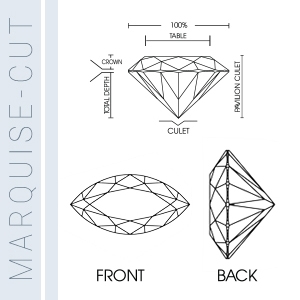
What is a Marquise-Cut Diamond?
Marquise diamonds feature a unique eye-like shape that gives them one of the largest surface areas of any diamond shape. This diamond shape features a total of 58 facets, featuring 33 on the crown and 25 on the pavilion. These facets will occasionally feature a French tip that replaces the large bezel facets at the points of the diamond with star and upper girdle facets.
Prized for its long and narrow pointed shape, the marquise-cut is essentially a modified brilliant diamond and, as a result, appears larger than it actually is. This unique phenomenon means that, like the emerald-cut, a marquise-cut diamond makes the wearer’s hands and fingers look longer and slimmer.
History of the Marquise-Cut Diamond
It was eighteenth-century French king Louis XV who originally coined this diamond shape’s name. Louis XV commissioned the marquise-cut to resemble his chief mistress’s lips. She was the Marquise of Pompadour, and Louis considered her lips to be "perfectly shaped."
Diamond cutters will refer to the marquise-cut with other names as well, such as a "Navette" shape (meaning "little boat" or "little ship" in French) as the shape appears to resemble the hull of a small ship.
Names for this diamond cut include:
- Marquise: a hereditary feudal title above a count and below a duke.
- Navette: as noted above, meaning “little ship” due to the cut’s hull-like shape
- Football: a popular nicknamed due to this cut’s elongated, pointed shape.
- Eye-shaped: speaks directly of the shape of the cut
With a history rooted in elite of Old-World aristocracy, the traditional nature of the marquise-cut fits beautifully on the ring finger and is a classic, refined choice for an engagement ring.
Grading System of Peoples Marquise-Cut Diamonds
At Peoples, we rely on trusted experts from different gemological laboratories to grade our precious stones.
To determine a diamond’s grade, these labs inspect each diamond under closely controlled lighting and viewing conditions. Trained grading professionals use highly calibrated measurement devices to capture important data for use in determining the marquise-cut diamond’s quality. These experts will then grade our marquise-cut diamonds on the following determinations:
Marquise-Cut Carat
Each diamond is measured using the carat weight system. Diamond experts use specially calibrated scales to ensure accurate measurements with weights measured to the hundred-thousandths of a carat. One metric carat equals 0.2 grams.
Marquise-Cut Clarity
Marquise-cut diamond clarity references the appearance of the stone, and it notes any blemishes or inclusions. Our experts grade diamond clarity as one of six grades – Flawless, Internally Flawless, Very Very Small Inclusions, Very Small Inclusions, Small Inclusions, or Imperfect.
Of course, much of diamond selection comes down to personal taste. Some blemishes may only be visible to a professional using specific equipment. Evaluating the clarity of a diamond can be as simple as noting whether it appears clear to the naked eye. You may prefer to know that your marquise-cut diamond is certified as Flawless while others may not mind minor blemishes that aren’t visible unless inspecting them with special equipment.
If your partner prefers a more ideal appearance, opt for a Flawless or Internally Flawless diamond. If small imperfections do not stand out to your partner, then you may prefer a Very Small Inclusions or Small Inclusions grade marquise-cut stone.
Marquise-Cut Colour
The industry standard system for grading marquise-cut diamond colour begins with a D grade (colourless) and continues with increasing levels of colour to a Z grade.
Diamonds are compared to master stones with known colour grades. Diamond experts utilize master stone sets that are chosen based on rigorous standards then tested prior to use. Master stones help experts determine diamond colour grades. Each master stone set must surpass rigorous standards before use in determining colour grades.
The human eye associates diamond colour with overall diamond size and its settings. The human eye may not detect small differences in diamond colour which account for significant differences in diamond price. Additionally, the setting colour and material chosen for the marquise-cut diamond can make a considerable difference in the colour of the diamond. For instance, of your diamond has a yellow tinge, it will appear brighter and lighter in a warm yellow gold setting.
Their long history and vintage appeal often inspire buyers to opt for warmer colours in marquise-cut diamonds instead of completely colourless varieties.
What Should I Look for in a Marquise-Cut Diamond?
Marquise-cut diamonds are most commonly found in engagement ring settings. While the look of a marquise-cut diamond is a personal preference, industry experts consider the ideal marquise-cut diamond to have the following features:
- Length-to-Width Ratio:
This is subjective to the end wearer, however, the ideal, industry-recommended length-to-width ratio for the marquise-cut is 1.90. - Table Size:
Ideally, a marquise-cut diamond features a large table for superior light reflection. - No Distinguishable Bow-tie:
Because of their narrow shape, every marquise diamond contains some semblance of a bow-tie. However, a well-cut diamond should have no visible dark area running through its centre. - Symmetry:
The two points at either end of a marquise-cut diamond should align with one another. This helps to avoid an off-balance or skewed appearance in the jewellery setting. - Proper Setting to Avoid Chips:
The sharp ends of a marquise-cut require a setting that protects the diamond’s defined edges from chipping. We highly recommend that you select a setting with prongs that protect the most susceptible points of this cut. For added security, we recommend using “V-tip” style prongs.
Marquise-Cut Diamonds: Conclusion
Romantic and dramatic, marquise-cut diamonds are experiencing a renaissance in engagement rings right now. The Old-World appeal of marquise-cut diamond is elegance exemplified. These unique, almond-shaped diamonds feature one of the largest surface areas of any other diamond shape, making them appear larger. Set vertically, the marquise-cut diamond also slenderizes and elongates the ring finger, making it perfect for those with wider or shorter hands. Set horizontally, the marquise-cut diamond takes on a modern edge.
Beautifully feminine with vintage-inspired elegance, find the marquise-cut diamond engagement ring of her dreams at Peoples Jewellers today.